Thursday, March 28, 2019

My Watershed Moment

Yesterday marked the 55th anniversary of the watershed moment that changed the direction of my life. The Great Alaska Earthquake, also known as the Good Friday Earthquake, interrupted my freshman year at Seattle Pacific College on March 27, 1964.

Seward, Alaska, before the 1964 Earthquake

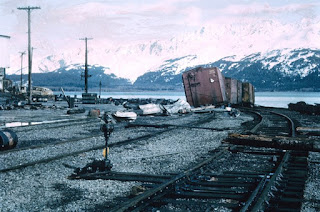
Seward after the 1964 Earthquake
My family the Christmas before the earthquake
(I am front left)

I grew up in a missionary family in Alaska in the fifties and sixties. We lived by faith on my dad's meager pastor’s salary. My personal faith grew as I experienced many answers to prayer. Feeling called to fulltime Christian service, I wanted to attend a Christian college, where I hoped to find a godly husband.

When I graduated from William H. Seward High School, I knew I couldn’t expect financial help from my family for college, but with a scholarship and money I’d saved from hundreds of hours of babysitting and ironing, I enrolled at Seattle Pacific College, an accredited Christian college closest to home.

Oil storage tanks burned for days
That memorable Good Friday in 1964, clocks stopped at 5:36 p.m. when the largest earthquake ever to hit North America struck Southcentral Alaska. Measuring 9.2 on the Richter scale (the Japan quake a few years ago registered 9.1), the quake centered in Prince William Sound, along the northern edge of the Gulf of Alaska. It generated tsunamis and devastated every city, town, port, connecting highway, and railroad in the region.

Railroad cars tossed like toys by the tsunamis
Horrified, I watched coverage of the destruction on television. Seward, a small port city just south of Anchorage, where my entire family lived, had been hard hit.


The docks were swallowed up by Resurrection Bay. Oil storage tanks ruptured, belching flames and black smoke for weeks. Homes were destroyed. Bridges were stranded 8-12 feet above shredded ribbons of highways. Several tsunamis carried burning debris inland, setting everything on fire. Many people were killed. For a torturous week, I didn’t know if my family had survived.

That summer, I returned home to a very different landscape. Miraculously, our church and parsonage had survived, but everything south of us was gone—many homes, the docks where my father had worked as a longshoreman to supplement his income, the shrimp cannery where I had pulled several night shifts while in high school.

Ninety-five percent of the industrial area had been destroyed. Family men couldn’t find work, let alone a single college girl.
And no one needed a babysitter.
Ninety-five percent of Seward's industrial area obliterated.

As that jobless summer progressed, I prayed and tried to have faith, but I knew it would take a miracle for me to return to college that fall. In July, evangelists visited our tiny church. We agreed together to make it a matter of special prayer, and my faith increased.


The first week of August, the local librarian asked me to help her catalog new books. She could only promise me babysitting wages (50 cents an hour at that time). It wouldn’t pay my way to college, but it was something useful to do!

While I was working at the library, a bulletin from the Ford Foundation arrived announcing an “Earthquake Relatedness” Scholarship for those who had lost a family member, property, or employment due to the earthquake. It would cover up to full expenses according to need. I was eligible.

But there was one catch. This scholarship was only for students attending universities in Alaska. I could not use it at Seattle Pacific College.

Although it was not what I’d hoped for, I knew this was God’s answer to my prayers. I immediately applied to the University of Alaska in Fairbanks and felt peace. At least I would be able to continue my education.

The week before school started that fall, I received my letter of acceptance and a scholarship covering full expenses for the year. It even included money for books, a fur parka essential to living in the interior of Alaska where the thermometer reaches 50 and 60 degrees below zero for weeks on end, and spending money. And all of my credits transferred. When I graduated three years later, the scholarship had covered all of my expenses for all three years.

But that’s not all. Not only did God meet my needs, He gave me the desire of my heart.

The first week of school that fall of 1964, I met a young man at Intervarsity Christian Fellowship. We married three weeks after our graduation in 1967. We will celebrate our 52nd wedding anniversary in June.

I often laughingly say, “God had to send an earthquake to introduce me to my husband.”

Thursday, March 14, 2019

Singing--Part 7: Turn Your Eyes Upon Jesus

"Turn Your Eyes upon Jesus," a song that has become well known and well loved, was written in 1918 by singer/songwriter Helen Howarth Lemmel and has been included in most evangelical hymnbooks ever since. I grew up singing the chorus of this song often in church in the fifties and sixties as part of the congregational song service, and it became one of my favorites:

Turn your eyes upon Jesus;
Look full in His wonderful face;
And the things of earth will grow strangely dim
In the light of His glory and grace. 

One night in my dorm room my freshman year of college, this song became especially dear to me. Feeling the pangs of unrequited love, I lay on my bed in the dark and came to grips with the fact that a summer relationship with a Christian young man had been simply a friendship, not a romance.

Me in college
My roommate and I had turned out our lights and were lying in our beds sharing our struggles about boyfriends. I knew she was hurting. 

To show her I understood, I mourned aloud how hurt I felt that I had not heard from this particular young man. I was shocked when she began to taunt me with words something like this: "You're always talking about trusting the Lord. Isn't this one of those times?"

Those words cut me. Hurt and tearful, I quit talking. But I couldn't stop thinking about what she'd said. Even though it hurt, she was right. Then, seemingly out of nowhere, the song, "Turn Your Eyes upon Jesus," popped into my head. 

As I sang it over silently, I felt as though I were literally looking into His wonderful face. And the things of earth grew strangely dim as I was lifted "into heavenly places in Christ Jesus," (as the Apostle Paul described in Ephesians 2:6).

The hurt was gone. I could cherish that special summer friendship. From it, I had discovered what I would look for in a husband. And I found that special someone the next year.

Now, when the challenges of life become overwhelming, I close my eyes and begin to sing, "Turn your eyes upon Jesus; look full in His wonderful face..." and He lifts me up to see life from His perspective. He gives me grace and strength to carry on. 


Thursday, March 7, 2019

Singing--Part 6: His Hands

Yesterday was Ash Wednesday, which marks the beginning of Lent, forty days of prayer, fasting, and penitence leading up to Easter. While our church does not observe Lent, I don't need Lent to be reminded daily of the sacrifice of the Lamb of God offered to take away the sin of the world--my sin.

Although I had probably heard the story of the Crucifixion prior to the age of five, I was five when I realized that I had sinned and that Jesus had died for me. It was in children's church on a Sunday morning in the church my grandparents had pioneered in Juneau, Alaska. I don't recall the time of year, but I remember clearly asking Jesus into my heart and life at that young age.

Courtesy Google.com
A song we often sang in church became very meaningful to me then and throughout my childhood and teens. I haven't heard it sung in many years now, but I still remember it:

He showed me His hands that were marred by my sinning;
He showed me His feet that were nailed to the tree;
I then saw His brow and His side deeply wounded;
And now I love Jesus, and Jesus loves me.

That chorus always speaks to me of how much Jesus loves me. That He would go through so much suffering for you and for me demonstrates the depths of His love for us.

I remember a story of a young orphan boy who was up for adoption. Several men had applied and stood before a judge to present what they could offer the child. One offered him wealth. Another promised him a good education. Finally, the last man, not as well dressed or as well spoken, came before the judge. 

"And what can you offer?" asked the judge.

The man held up his terribly scarred hands. "I offer him myself and my love. I may not be as wealthy or as well-educated, but I love him. I am the one who saved him from the fire that killed his parents."

A hush fell over the courtroom. The judge, choked with emotion, finally spoke. "This man has already proven his love for this boy. He is awarded the right to adopt him."

Jesus' nail-scarred hands prove His love for us. As 1 John 4:19 says,

Courtesy Google.com
How can we refuse such love?

Thursday, February 28, 2019

Singing--Part 5: Singing Scripture

Me in high school
While I was in high school, I was the school chorus soloist and was often asked to sing for special events--talent shows, weddings, funerals, etc. During my senior year, the churches of Seward, Alaska, combined their choirs to sing Handel's Messiah for Easter. At the time, I knew nothing about this perhaps best-loved oratorio of all time, but I was asked to sing the soprano solos.

As a child, I had memorized many Bible verses and even chapters of the Bible. Even before I started school, my mother taught me a Bible verse for every letter of  the alphabet, just as her mother had taught her. (For a list of those verses click here.) Then during summer Vacation Bible Schools, I always stepped up to the challenge to memorize Scriptures. One summer, I won my first very own Bible by memorizing the most verses.

I soon discovered that the libretto of the Messiah is entirely Scripture--passages from both the Old and New Testaments of the prophecies concerning the coming Messiah, His birth, life, death, resurrection, ascension, and second coming--all set to perhaps the most inspired music of all time.

George F. Handel courtesy Google.com
George Frideric Handel, I learned, was born in Germany but had settled in London in 1710, as a young man. He had composed many operas and oratorios, as well as court music, and was well-established in English society and music circles.

Eventually, society tired of his Italian operas, and his debts mounted. Due to the pressures of his debts, he suffered a stroke that paralyzed his right arm. His doctors believed it had also caused a permanent brain injury and his days as a musician were over.

But Handel refused to give up and surprised everyone when he miraculously recovered his strength and declared, “I have come back from Hades.”

In 1741, still in debt and 56 years of age, Handel received a libretto from Charles Jennens, a poet he had worked with previously. He sequestered himself for 23 days and, writing night and day,  composed the entire 260-page oratorio, which he entitled Messiah. The work was debuted in Dublin on April 13, 1742, and was soon recognized as his greatest work. To this day, the Baroque-era oratorio still awes listeners 250 years after the composer’s death.

I immediately fell in love with Handel's Messiah. I have sung it in choirs several times since. Every Christmas I listen to my CD of it and sing along.

One thing I discovered is that singing the Word of God is just about the best way to memorize Scripture. The melodies bring the words along with them.

That Christmas in high school I sang the aria in the Messiah, "I Know that My Redeemer Liveth," from the Book of Job and echoed by the Apostle Paul in 1 Corinthians 15:20. It quickly became my favorite.

As part of my senior vocal recital in college, I performed another aria from the Messiah, Romans 8:31-34, "If God Be for Us Who Can Be Against Us?" What a precious promise!

In the 70s and 80s, I loved the Scripture choruses, which helped me learn even more Bible verses. I can hardly read the Psalms without bursting into song frequently. I find that the verses I memorized as a young child and the ones I learned set to music are the ones I can still quote word for word as I grow older. The Psalmist wrote,

Psalm 119:11, NKJV Courtesy Google.com
I recommend it!

Check out my books on my website: http://annaleeconti.com/books.html


Friday, February 22, 2019

Singing--Part 4: Sunsets

Sunset over Denali Courtesy Google.com
I love sunsets. My favorite posts on Facebook are sunset photos. Due to the long twilights in the winter, as well as the mountains, sea, and snow, Alaska has some of the most awesome sunsets.
Clouds in the sky make the most beautiful sunsets.

As a teenager, I discovered a song, "Just Enough Clouds," by Bill and Gloria Gaither. It isn't one of their best known songs, but it struck a chord within me. The first couplet of  the chorus says: "I want just enough clouds in my sky to make a beautiful sunset." 

Even as a teenager, I had noticed that some elderly people were sweet and joyful, while others, even some Christians, were crotchety and grumpy. They seemed to complain a lot and seldom did a smile cross their faces. They worried and talked constantly about how difficult life was. I wondered what made the difference.

Grandma & Grandpa Personeus
I'd had a close relationship with my Personeus grandparents all of my life. They had spent their lives as pioneer missionaries in Alaska. Unselfishly ministering to people in need, they had often endured hardship and illness. Yet, the joy of the Lord was evident in their smiles and actions. They were always praising the Lord and telling stories of how God had healed them and supplied their every need.They were fun to be around. Children, teens, and adults alike loved to be with them

My freshman year at Seattle Pacific College, our dorm mother once asked us girls, "When are you going to start being what you'd like to become?"

That's when it all clicked. I wouldn't just suddenly become a sweet little old lady when the I got old. No, what I did and how I responded to life when I was young is what I would become, and even more so when I got old. I needed to start becoming then what I wanted to be in my sunset years.

The song, "Just Enough Clouds," goes on to say, "I want just enough tears in my eyes to make the rainbow appear." Rainbows are formed when the sun shines through the rain. The raindrops act like  tiny prisms refracting the white light into its spectrum of colors. It's the heartaches and tears we experience in our lives that, when given to God, soften us and teach us and allow the beauty of Jesus to shine through us. They mold us and make us what He wants us to be.

So don't be afraid of the clouds and tears and heartaches that come. Just remember Romans 8:28:


How can bad things bring good? The next verse tells us how:


The good is that through the things we suffer, we are conformed to the image of Christ. God uses the trials of life to make us what He wants us to be--like Jesus!

Yes, as the song says, "I want just enough rain and just enough pain to make me what He wants me to be." I'm not totally there yet, but that's my goal!

Click title to listen to Just Enough Clouds on YouTube.


Thursday, February 14, 2019

Singing Part 3: Submission

The Personeus-Cousart Family in Seward, Alaska, in 1963, the year I graduated from high school 
Perhaps growing up in a missionary family made me more aware of worldwide missions. My grandparents, pioneer missionaries to Alaska, were not the only missionaries in my family. Several of their brothers and sisters served in India, Chile, and Africa.

In school whenever I was required to read a biography, I chose a missionary biography. One that really touched my heart was the story of David Brainerd, who poured out his life ministering to Native Americans in New Jersey, New York, and eastern Pennsylvania in the 1740s, and died of consumption at the young age of 29 in the home of the well-known preacher of the First Great Awakening, Jonathan Edwards.

I also read the biographies of William Carey, who became known as the Father of Modern Missions; Adoniram Judson, who translated the Bible into Burmese; Hudson Taylor, missionary to China; and the well-known David Livingstone, missionary to Africa.

The movie, Through Gates of Splendor, about the five missionaries martyred along the Amazon River in Ecuador, also stirred my heart. Jim Elliot, one of the men who was killed by the Auca Indians, had also been motivated by the ministry of David Brainerd.

As I began to sing more solos in church, the theme of Christian service flowed through many of the songs I chose: "My Task," "I'm His to Command," "I Will Serve Thee," "Make Me a Blessing," "Come and Tell Us of Jesus," and "Submission," an old gospel song with a powerful message, written by C. Austin Miles, Philadelphia pharmacist turned hymn writer. The lyrics of "Submission" really arrested my attention. (Click the title to listen to it on YouTube.)


1.     The path that I have trod,
Has brought me nearer God,
Though oft it led through sorrow's gates .
Though not the way I choose,
In my way I might lose
The joy that yet for me awaits

Chorus:
Not what I wish to be,
Nor where I wish to go,
For who am I that I should choose my way?
The Lord shall choose for me,
'Tis better far, I know,
So let him bid me go, or stay

2.     The cross that I must bear,
If I a crown would wear,
Is not the cross that I should take;
But since on me 'tis laid,
I'll take it unafraid,
And bear it for the Master's sake.  

3.    Submission to the will
Of him who guides me still
Is surety of His love revealed;
My soul shall rise above
This world in which I move,
I conquer only when I yield.

I had always wanted to go to a Christian college. During my freshman year at Seattle Pacific College (SPC), I attended a mission service. The speaker suggested that we should consider ourselves called to full-time Christian service unless the Lord definitely directed us otherwise. I had never heard it put that way before. I remember praying that night that if God wanted me to be a missionary, He would direct the circumstances of my life in that path.

A few months after I prayed that prayer, a 9.2 magnitude earthquake devastated Southcentral Alaska, where my parents were missionaries. Ninety-five percent of the industrial area of our town of Seward was destroyed.

I had planned to work in the shrimp cannery on the waterfront that coming summer to pay for my next year at SPC. But the cannery had been swept away in the tsunami. And the docks where my father worked as a longshoreman to supplement his meager ministry income was gone too. I could find no work that summer, so I had no money to return to SPC that fall. That's certainly wasn't part of my plans for my life!

Our graduation day in 1967
Then I learned that Ford Foundation had set up an Earthquake-Relatedness Scholarship. Since my father and I had lost employment due to the earthquake, I qualified. But it could be used only in colleges in Alaska. At that time, there were only two, one in Anchorage and one in Fairbanks. I chose the University of Alaska in Fairbanks.

There, I met my husband. He was planning a career in the Army. After much prayer, I felt God wanted me to marry him.

After his tour in Vietnam, God began to move in his heart to go into full-time ministry in the Northeast. He resigned his commission, went to Bible school and seminary. In 1977, we came to New York to pioneer a new church in Gloversville. After 40 years of ministry in three churches in New York State, we are now retired from active pastoring. Our ministry now is to be encouragers in our local church.

The path by which God leads us may not always be the way we might choose for ourselves, but we've found that submission to the will of God is best. And He has blessed our lives beyond our expectations.


Friday, February 8, 2019

Singing Part 2: How Big Is God!

Aurora Borealis at Bear Lake, Alaska
Courtesy Google.com


Growing up in Alaska, I acquired a keen sense of the greatness of God as Creator at a very young age. Surrounded by magnificent evergreen-clad mountains that rose abruptly from the waters of the Inside Passage high into the sky, I would look around and see God's amazing creation every day.

I felt close to God as His creation hugged me every day while I walked to school or rode in the car.

The colorful neon displays of the Aurora Borealis on a clear, crackling winter night left me awestruck with their curtain-like shapes waving high in the sky. Then, of course, I had no comprehension of the science behind those constantly moving magnetized electrical currents in the magnetosphere and ionosphere that produced those ethereal sights. I just knew that God set them in motion.

Even the stars declared God's glory to me. The midnight blue expanse of sky stretched from peak to peak. With few city lights to fade them, the stars twinkled so close I could almost reach out and trace the constellations.  

In my early teens I heard a song that was made popular by the singing of George Beverly Shea in the worldwide crusades of Evangelist Billy Graham: "How Great Thou Art." That song spoke to me, and I began to sing it as a solo. Now, it may be one of the best known and well-loved hymns of all time.

Yellowstone Canyon
Courtesy Google.com
As a young adult, I visited Yellowstone National Park on a Sunday morning. Standing on the rim looking down into Yellowstone Canyon with the river flowing from its Lower Falls, I felt the breeze lift my hair. As I listened to birds twitter and the roar of the falls, I was reminded of the second verse of "How Great Thou Art," and I burst out singing all four verses at the top of my lungs across that vast canyon. That song still brings me to tears fifty years later.
Another song I learned when I was in high school and was first introduced to the theory of evolution was "How Big Is God." It was written by country-western singer and song-writer, Stuart Hamblen. His father was a preacher, but Stuart turned his back on Christianity. He became a hard-drinking, foul-talking cowboy actor. But his wife Suzie was a believer. When Billy Graham did a series of meetings in Los Angeles in 1949, Suzie encouraged Hamblen to attend. 

He did, and the message of the gospel so stirred his heart that he was unable to sleep that night, thinking about his sinful life, and where he was heading in the end. About four in the morning, he called the hotel where the Graham team was staying and asked to see Dr. Graham. He arrived at the hotel an hour later and made a decision to trust Christ as his Saviour.

The power of God changed Hamblen's life completely, and he became an effective ambassador for the Lord Jesus. He wrote many gospel songs, such as "It Is No Secret," "This Old House," and "Until Then.". Overwhelmed at what God had done, he wrote a song especially for Billy Graham’s soloist George Beverly Shea to sing, "How Big Is God." The chorus joyfully exclaims:

How big is God!
How big and wide His vast domain!
To try to tell these lips can only start;
He’s big enough to rule His mighty universe,
Yet, small enough to live within my heart.

And these songs became my testimony in response to the theory of evolution.