Thursday, November 16, 2023

The First Thanksgiving in America


Why We Give Thanks

Despite the challenges we as a nation face politically, economically, and culturally, we are still blessed to live in the United States of America. Thanksgiving Day is coming soon when Americans gather with family and friends to enjoy a bountiful feast. Many today have forgotten the  true meaning of Thanksgiving Day, calling it Turkey Day. As Christians, we celebrate by thanking God for the many blessings He has bestowed upon us individually and as a nation.

The Apostle Paul faced many challenges, yet he knew the importance of giving thanks to God. He reminds us in 1 Thessalonians 5:16-18 to
Courtesy Google.com

The Pilgrims too faced many hardships in the year leading up to their first Thanksgiving celebration. Some public school textbooks tell children that the Pilgrims were giving thanks to the Indians, but in his historical work, Of Plymouth Plantation, penned by Governor William Bradford, the leader of the Pilgrims described what really happened:

The Pilgrims' journey began in Holland. They had left England, where they had no religious freedom, to settle in Holland, where they were free to worship God as they pleased. But there, the culture was so corrupt they made plans to go to the New World to build a community based on biblical principles for their children.

Governor Bradford wrote, "Last and not least, they cherished a great hope and inward zeal of laying good foundations, or at least making some ways toward it, for the propagation and advance of the gospel of the kingdom of Christ in the remote parts of the world, even though they should be but stepping stones to others in the performance of so great a work."

The journey to America on the Mayflower was unbelievably miserable. Bradford described how 102 Pilgrims were crammed into a space the size of a volleyball court for 66 days at sea with little light and no fresh air since all the hatches had to be battened down due to stormy weather. Can you imagine the stench? Their diet consisted of dried pork, dried peas, and dried fish.

They arrived in New England late in the fall of 1620 just in time to prepare for winter. During that first winter, 47 of the 102 Pilgrims died. Only three families remained unbroken by death. Yet, they were thankful even though their daily rations at times consisted of only one kernel of corn.

That spring, the Indians befriended then, showing them how to plant maize and fertilize it with fish. When a drought threatened to destroy the crops, they fell on their knees and prayed until God sent rain.

The First Thanksgiving Courtesy Google.com
The proclamation of the first Thanksgiving came as a result of their first bountiful harvest. The Pilgrims were overflowing with gratitude to God because the harvest of 1621 provided more than enough corn to see them through their second winter.

Indian Chief Massasoit brought 90 Indians with him to the feast, arriving a day early. The Pilgrims despaired that they would not have enough to feed that many without dangerously diminishing their winter supply of food.

As it turned out, the Indians had come early to hunt and contribute to the feast. They provided five dressed deer and more than a dozen fat wild turkeys--enough food to extend the celebration to three days.

The Pilgrims were able to rejoice and remain hopeful even in the midst of death and privation because they knew their lives served a greater, eternal purpose. When we know and follow Jesus Christ, our lives too have that same eternal purpose. That alone gives us a reason to rejoice and be thankful, no matter what our outward circumstances may be.

Courtesy Google.com


Psalm 69:30 encourages us to "magnify the Lord with thanksgiving." A magnifying glass makes objects seem bigger to us. Thanksgiving makes God bigger to us--it makes us see Him better, see His ability to supply all our needs. When we thank Him for what He has done for us in the past, our faith is built up to know He will meet our needs today. Before you enjoy your Thanksgiving dinner, pause to give thanks to our Heavenly Father for His blessings to you this year.

Friday, December 10, 2021

Conti Christmas Chronicles 2021


If we thought 2020 was troubling, as another Christmas season approaches, the daily news is still very upsetting, not much different than that first Christmas when Jesus came as a tiny Babe born in a manger. “His name shall be called Immanuel, God with us,” the angel told Joseph. Jesus came to bring hope and peace into the hearts of all who accept Him. “In the world you will have tribulation,” Jesus told His disciples, “but don’t be afraid. I have overcome the world” (John 16:33). “Peace I leave with you,” Jesus continued. ”My peace I give to you; not as the world gives do I give to you. Let not your heart be troubled, neither let it be afraid” (John 14:27). How thankful I am that “Jesus Christ is the same, yesterday, today, and forever” (Heb. 13:8)! He is still in control, even in the midst of all the chaos of this world. His peace sustains us in the midst of trouble. And one day, Jesus, the Prince of Peace, will rule and reign with justice and true liberty. What a day that will be!

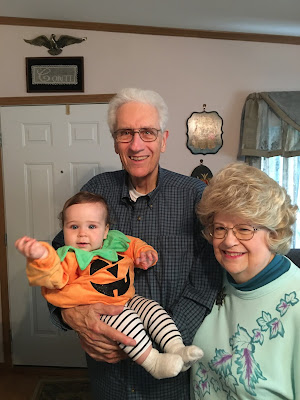
A joyful event took place on January 16, 2021: Phoebe Ray Conti was born to our grandson, Stephen, and his wife, Naomi, at 2:26 p.m., weighing in at 8 lbs. 12 oz. and 20 inches long, making us great-grandparents. They live nearby. What a joy she is!


Our little pumpkin, Phoebe Ray (9 1/2 months),visited us at Halloween

This year has also been a season of loss. As I mailed out our Christmas letters last year, word came that Bob’s only sibling, Mary, who was 9 years younger than he, had passed away in Utah on December 20. On November 2 of this year, Bob’s only remaining uncle (age 86) died in Colorado leaving him and his two cousins at the head of the Conti family.

After three procedures on his varicose veins, Bob’s legs have healed, and he’s had no more scary bleeding episodes. Not being able to follow his daily routine of walking for nearly a year due to his veins, though, we were alarmed that his chronic congestive heart failure had become much worse. He could hardly function. After much prayer, changes in his medications, and a gradual return to walking, he is feeling much better now. PTL!

For the past 20 years, I have been seeing a pain management specialist for my back pain. My implanted spinal cord stimulator (SCS) I’ve had since 2007 was no longer providing sufficient relief. After a CT scan last December, he told me I needed to see a spinal surgeon at the Hospital for Special Surgeries in NYC, where I was told I have very advanced degenerative disc disease. Many of the discs are totally gone. The surgeon prescribed 12 weeks of physical therapy in preparation for a 7-level spinal fusion in the lower thoracic-lumbar spine. After I had my SCS removed, I had further scans and MRIs that showed that in the past year I have developed significant osteoporosis that would make the outcome of surgery dismal. My pain management specialist suggested an implanted intrathecal (spinal canal) morphine pump, but when I had the trial injection, I had such severe itching that I decided against it. I continue with monthly chiropractic, massage therapy, and acupuncture, but I can’t tolerate any pain meds except aspirin and topical pain patches and creams. Bob takes good care of me. I’m still trusting God for healing.

This year, I was able to teach three all-day classes for the New York School of Ministry and continued to facilitate the local library’s women’s writing group every Wednesday via their GoToMeeting site until we discontinued them in late summer. In October, I also enjoyed an all-day meeting with ministry wives from our region. Bob is my chauffer in our new white pearl Toyota Camry. Even though we did get the vaccines, we haven’t gone back to church yet due to our “comorbidities.” Sadly, several of our friends at church have died of COVID. We miss seeing everyone.

The family is doing well overall. After teaching virtually for a year, Bob B. is back to the classroom. Sonny has joined Sabrina, Stephen, and Spencer in working at Adams, a local chain of stores that began as a farm-to-table store. Naomi works at Stewart’s. She and Stephen plan their schedules so they don’t need a babysitter. Sam gives Huguenot tours in New Paltz, NY. Sophia and her boyfriend visited from San Diego in August, and we enjoyed a family reunion at Bob B.’s. This year, after a stay-at-home last year, we are looking forward to celebrating Thanksgiving and Christmas with the family too.

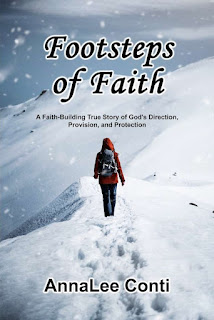
My fifth book, Footsteps of Faith, was released this year. Its prequel, Frontiers of Faith, is being republished in the next few months by Stratton Press and will include an e-book as well as a paperback edition. They, as well as my Alaskan Waters Trilogy of historical Christian novels based on true stories my Personeus grandparents told about their early days in Alaska (Till the Storm Passes By, A Star to Steer By, and Beside Still Waters), are available through Amazon.com, Barnes & Noble, and iTunes and are featured on my website at www.AnnaLeeConti.com.

I love connecting with many of you on Facebook, and we look forward to your Christmas cards and letters. Best wishes for a merry Christmas and a blessed New Year.

Love, AnnaLee & Bob


Sunday, May 2, 2021

What Is Eternity?


I've been thinking a lot more about eternity lately. I'm 75 and dealing with debilitating pain due to advanced degenerative disc disease, spinal stenosis, scoliosis, and osteoarthritis. It causes me to be even more aware of my mortality.

While sorting through some files, I came across a poem I wrote for children years ago, "What Is Eternity?"


WHAT IS ETERNITY?

"What is eternity?" you asked me one day.

I thought it over, then I knew what to say.

Picture the sandy beach where you love to play;

Picture a little bird alighting one day;

Into his beak he takes a wee grain of sand;

Off he then flies to a way faraway land;

One long year later he returns from his trip;

Down he then swoops to take another wee bit;

Year after year bird makes one run after run;

When all the sand is gone, eternity's just begun!

                                                              --AnnaLee Conti


Growing up in a missionary family in Alaska, I became aware of my Creator at a very young age. In church, we often sang a chorus written by Alfred B. Smith, "With Eternity's Values in View." 

And a plaque on my grandparents' wall made a solemn  impression on me: 

Only one life, 'twill soon be past;

Only what's done for Christ will last.

As I grew up, the question that always guided my decisions in my life was "Will it count for eternity?"

Ecclesiastes 3:1, 2, tells us 

To everything there is a season, a time for every purpose under heaven: 

a time to be born, and a time to die.

The Bible also makes it clear that God knows the number of our days. Not one of us knows the hour of our death. Some die young of illness or in accidents or war, but I read recently that old age begins at 80 now! Psalm 90:10, 12 (NKJV) says, 

"The days of our lives are seventy years; 

And if by reason of strength they are eighty years, 

Yet their boast is only labor and sorrow, 

For it is soon cut off, and we  fly away...

So teach us to number our days, 

That we may gain a heart of wisdom."


It is not macabre to think about death and eternity. God says it is wise! 

As I look back over my life, another song by Dean Bernstrom comes to my mind: "I Wonder Have I Done My Best for Jesus?" It continues, "... when He has done so much for me." When I see Jesus face to face, I want Him to be able to say to me, "Well done, good and faithful servant....Enter into the joy of your Lord" (Matthew 25:21).


Thursday, February 18, 2021

How I Became a Writer

I was born in Philadelphia, Pennsylvania. How I ended up in Alaska is a story in itself, one of which I share in my new memoir,  Footsteps of Faith, a Faith-Building True Story of God's Direction, Provision, and Protection in my life. Available now in paperback. Coming soon in e-book.

 I grew up in Alaska in the fifties and sixties in a missionary family. We were avid readers. My Grandma Personeus was a storyteller and kept everyone entranced with her accounts of her and Grandpa’s early days in Alaska (1917-1982). When we visited them each summer during my childhood, she read books aloud to us—books she’d enjoyed as a child. 

Grandma was a prolific poet and wrote curriculum for Sunday school quarterlies and articles for church magazines. My mother also wrote continued stories and composed songs for us and for her Sunday school class.

As a young teenager, I discovered Christian fiction. We had no TV in Alaska back then. To provide good reading material for cold, dark winter evenings, my father subscribed to a Christian book club. We could hardly wait for the two selections that arrived each month. Those pages influenced my worldview and my attitudes about life and love. When I read the nine Christian fiction books written by my great aunt under the pen name of Zenobia Bird, I dreamed of writing my own novels.

 In high school, I began writing about the sights I’d seen and the experiences I’d had. I got my start in writing for publication while my husband was in seminary when I worked in the editorial area of Gospel Publishing House. The editors I worked with encouraged me to write and submit short stories and articles for their publications. Soon, I was given assignments to write Sunday school, vacation Bible school, and children’s church curriculum. When we began pastoring, I continued to write on assignment for Gospel Publishing House for more than 25 years. 

Alaska provided the setting for my stories. It wasn’t hard to fictionalize my family’s experiences of living by faith in Alaska, stories that are carriers of truth about God’s love, forgiveness, grace, and mercy, because I learned to know God there.

 In 1973, while my husband was in seminary and I was working at Gospel Publishing House in Springfield, Missouri, my Personeus grandparents visited us from Alaska. Grandma gave me a packet of papers, saying, “Many people have asked me to write our story, but I’m too old to see it through by myself.  So I’m placing all my written accounts in your hands to do with as you think best.”

 Nearly 10 years later, while we were starting a new church in New York State, my mother-in-law invited me to her home to write the first draft of my first book. For one week, I holed up in a bedroom in her house and wrote on an electric typewriter, stopping only for meals, which she prepared. I wove together the short accounts my grandmother had written about their experiences and filled in the spaces between. Due to the downturn in the economy, though, I was unable to find a publisher. In the next few years, I retyped the manuscript into a Smith-Corona word processor. In 2002, I discovered a print-on-demand publisher and was able to get the word processor disc converted to MS Word. My uncle (their son) paid to have Frontiers of Faith published, and I reimbursed him from book sales.

While writing Frontiers of Faith, I came across several stories that triggered my imagination for historical Christian novels. For years, I’d been writing them my head. In 2007, I joined a writer’s critique group at the local library to begin fulfilling my lifelong goal of writing novels. 

I learned a lot from that group that included published authors and began writing a minimum of one chapter a week. In 2013, I published Till the Storm Passes By. By 2017, my next two books, A Star to Steer By and Beside Still Waters, completed my Alaskan Waters Trilogy, the life and death saga of a fictitious Norwegian immigrant family who battles the beautiful but often treacherous waters of early twentieth century Southeast Alaska to find love and happiness in the midst of tragedies, based on the stories Grandma Personeus told.


During those years, I started this blog, “Nuggets of Faith,” including many stories from my life. When I read a book about how to blog a book, I decided to develop these stories into a memoir, Footsteps of Faith, that has just been released by ReadersMagnet. It is now available at Amazon and Barnes & Noble in trade paperback. The e-book is coming soon on those sites as well as iTunes.

 Why do I write?

Writing is hard work and involves a great investment of time, but I can’t not write. I write because I have stories of faith to tell. God has called me to write stories that are carriers of truth about His love, forgiveness, mercy, and grace.

On a personal note: In January, we became great-grandparents when Phoebe Ray Conti joined our family. What a thrill!


Links:

Website: www.AnnaLeeConti.com

Email: FrontiersofFaith@AnnaLeeConti.com

www.Facebook.com/AnnaLeeConti.Author

Twitter: @AnnaLeeConti

www.goodreads.com/author/show/2562235.AnnaLee_Conti

www.amazon.com/author/annaleeconti


Wednesday, December 23, 2020

Colors of Christmas

I love all the colors of Christmas:

  • Stained glass windows in churches
  • The many colorful lights that adorn trees and houses
  • Red poinsettias and holly berries, red velvet dresses on little girls in the Christmas program and red bow ties on choirboys
  • Pine green Christmas trees and wreaths, shiny green holly leaves, and powdery green mistletoe
  • Silver tinsel, silver bells, icicles, moonbeams reflecting on new fallen snow, and stars twinkling in the deep blue of the nighttime sky 
  • Gold ornaments and ribbons on gaily wrapped gifts
  • Purple mountains and purple robes on  the Wise Men
  • Pure white snow that transforms the dreary landscape into a glistening winter wonderland
All those colors inspired me to write this poem:

COLORS OF CHRISTMAS

Silver stands for our redemption,
purchased at great cost.
Red stands for the blood of Jesus,
shed to save the lost.
White stands for the purity of our 
robes of righteousness;
Washed white as snow by Jesus' blood,
we stand in holiness.
Green stands for our Christian growth;
to feed on God's Word is a must.
Blue stands for our loyalty to Christ
in whom we trust.
Purple stands for His majesty;
King of kings is He.
Gold stands for the heavenly place
He has prepared for me.

by AnnaLee Conti

As you enjoy all the colors this Christmas, I pray that you will experience the myriad facets of the Light of the World, JESUS, whose birth we celebrate at Christmas.

Merry Christmas! 


Update on Footsteps of Faith: 


Due to the pandemic, the publication is taking a bit longer than I had hoped. The projected released date is now late January 2021. 


Thursday, October 1, 2020

The Oak and the Ivy

Our travels this year have been limited to trips to the doctors, to Newburgh to visit our son and pick up packages (our mail is delivered to a box at the front of our manufactured homes park, so we must pick up packages at the post office, which we want to avoid during this pandemic), and to the Commissary at West Point, where the military police monitor social distancing, etc. Occasionally, we take a short drive locally.

A few days ago, Bob and I drove south from Newburgh along the Hudson River past West Point, across the Bear Mountain Bridge, and north on the east side of the river to our home in the Town of Fishkill. We love the fall. We were looking for color but found little change yet.

Then I spotted some rich red color entwining the trunks of some of the still-green trees--poison ivy, the first color to appear in fall in our area. 

A chorus we'd sung often in church during my childhood suddenly popped into my mind. I hadn't sung it in years, but the words flowed quickly:


He's the Oak, and I'm the Ivy

He's the Potter, I'm the Clay

He's the Oil, and I'm the Vessel

I'm the Traveler, He's the Way

I'm the Flower, but He's the Fragrance

I'm the Lamp, but He's the Flame

He's the Words I sing to Music

I'm the Bride who bears His Name!


Who can begin to put into words all that Jesus is to the believer? Metaphors help. 

As a writer, I love metaphors. Perhaps that's why I love these lyrics so much. These metaphors give wonderful insights into our relationship with Him. He is our all in all.

Oak trees are strong and solid. Jesus is strong, and we can depend on Him at all times.

The nature of any ivy is to cling. It entwines around tree trunks, climbs up the sides of houses and even up telephone poles, and hangs from wires that cross roadways. 

Poison ivy gives a nasty rash. Our son had such a severe case of poison ivy poisoning in high school that he needed steriod treatments. 

Not all ivies are poisonous. In fact, common ivy, often a house plant, was a symbol of love and friendship in Europe in medieval times and was once traditionally given to newlyweds by their priest. Perhaps that is why many bridal bouquets contain ivy. 

Like ivy clinging to the oak tree, the older I grow, the more I cling to Jesus. Sometimes life has been quite difficult, but Jesus has never failed me yet.

What is your favorite metaphor for what Jesus means to you?


Coming Soon!


Thursday, September 24, 2020

Footsteps of Faith Cover Reveal


Here is the cover for my upcoming book, Footsteps of Faith, my faith-building memoir of God's direction, provision, and protection in my life.

Topics include

1. My parents' testimony of traveling from Pennsylvania to Alaska with two toddlers on $15.00 in 1948.

2, Growing up in a missionary family in Alaska in the fifties and sixties where I became aware of my Creator at a young age and learned to trust God to supply all my needs

3. How the Great Alaska Earthquake affected my life  

4. How my husband's experiences in Vietnam led him into full-time ministry

5. How I overcame fear    

6.  How I became a writer and an ordained minister

7. How I learned and grew through life’s challenges

Here are three introductory paragraphs from the Introduction of Footsteps of Faith:

"My story began long before I was born--from French Huguenot martyrs in 1685, whose sole surviving son immigrated to William Penn's colony in American for religious freedom. The limbs of his family tree are filled with missionaries and ministers seeking to spread the Word of God our ancestors gave their lives to protect.

"My maternal grandmother, Florence LeFevre Personeus, gave me a navy blue, hardbound book entitled The Pennsylvania LeFevres. 'This is the genealogy of my family dating back to 1510 in France, compiled by my father, George Newton LeFevre.'

"The lists of names inside reminded me of the genealogies in the Bible, which I usually skipped so I could devour the exciting stories. The book didn't look too interesting until she showed me a picture in it of the LeFevre Family Bible. Smoothing her snow white pouf of hair that framed her delicate features, she related the unforgettable story of the wife of Abraham LeFevre and mother of Isaac, our first American ancestor, who baked the family Bible in a loaf of bread..."

Today, this Bible can be viewed upon request at the Lancaster County Historical Society

and is one of the most requested items from the collection. This Bible belonged to the French Huguenot family of Isaac LeFevre. Sixteen-year-old Isaac survived the massacre after the Edict of Nantes was revoked in 1685 and was able to smuggle the Bible out of France as he escaped with the Ferree family. I was privileged to view it in person on one of my visits to Lancaster County.


My prayer is that the story of my life will encourage and build your faith in God.

Look for further announcements about my soon-to-be released book in the coming weeks. 

Thursday, July 30, 2020

Coming Soon!

FOOTSTEPS OF FAITH

The Faith-Building True Story of God’s Direction, Provision, 
and Protection in the Life of the Granddaughter of Charles and 
Florence Personeus, Pioneer Missionaries to Alaska
by
AnnaLee Conti

Growing up in a missionary family in Alaska, AnnaLee became aware of her Creator at a young age. From her parents’ and grandparents’ example of living by faith, she learned to trust God to supply her every need.

The devastating Good Friday Earthquake of 1964 brought AnnaLee and her husband together when she transferred to the University of Alaska Fairbanks on an earthquake-relatedness scholarship. Bob Conti planned a military career. His testimony spans three continents—from a tree in Greece to a dark night in Alaska to a bloody battlefield in Vietnam.

Through a historic flood in Fairbanks, a fear-filled tour in Vietnam, and an Army assignment in Rhode Island, God directed the Contis’ footsteps into full-time ministry in New York State. The author shares their journey in this exciting sequel to Frontiers of Faith.

Author Bio:
An ordained minister, author, and teacher, AnnaLee Conti earned her B.A. at the University of Alaska Fairbanks and her M.A. at the Assemblies of God Theological Seminary. She served as Minister of Christian Education and Music in their churches and teaches Bible and theology to ministerial students. For 25 years, she wrote many articles, stories, and curriculum for Gospel Publishing House and has published Frontiers of Faith and the Alaskan Waters Trilogy of historical Christian novels.


* * * * *

It's been several months since I've been able to write on my blog. After dealing with my health concerns and getting my manuscript off to the publisher, my internet connection became very unreliable. Every time I sat down to write something, it would be off. Then for a week, we lost all internet, cable T.V., and telephone. Last Friday, a technician finally came to fix it and discovered that the cable from the pole to our house was damaged. It has been replaced, and everything is working normally again.
Above is the announcement that my newest book is coming soon. The above is the back cover copy. I'll post a picture of the cover in a few weeks.

Friday, April 10, 2020

They Killed My Son Today!

They Killed My Son Today!

When my son was young, the agony Mary must have experienced watching her Son die on the cross became very real to me, and I wrote this story. On her bed that night, how she must have been haunted by His suffering as she relived that awful day !

They killed my son today! I pound my pillow trying to expend my rage. Angry tears pour down my cheeks.

"Crucify him! Crucify him!" That's all I can hear. I clamp my hands over my ears, yet still I hear their yells.

Just last week the crowd wanted to crown him king. Today, they shouted for his blood. How fickle they are! His trial was a mockery of justice. And Judas--one of his closest friends. How could he betray him?

John has been so kind. The house is quiet now. But this stillness only seems to magnify the sickening thud of the hammer driving those spikes into his hands and feet. Oh, God, will I ever be free of those sounds?

His hands. I held those baby hands, and the fingers closed tightly around mine. Those small boy hands patted my arm so gently when I had a headache. Those young man hands became calloused working in the carpenter shop with Joseph. Those manly hands blessed the little children, healed blind eyes, raised the sick, multiplied the loaves and fish. They never did anything wrong. Why would they pound rusty nails into those loving, kind hands?

His feet. I remember his first steps. Joseph had just come in and Jesus, forgetting himself in his pleasure of seeing Joseph, let go of the table and tottered toward Joseph, saying, "Up! Up!" I remember listening for his footsteps each evening when he and Joseph would come home from the carpenter shop. His step was always the first to ring out on the cobblestones. He was so full of life. And now he's dead.

Oh, my son, my son! I'll never hear your gentle voice again. You'll never sit down with me after supper and tell me of your dreams. I didn't always understand what you said, but just being with you, listening, was enough.

What are these words coming into my mind? "This child will be rejected by many in Israel...And a sword will pierce your very soul." I'd nearly forgotten those words of Simeon. Is this what he tried to tell me?

Words my son spoke suddenly begin to vibrate in my soul: "I am the resurrection and the life."

Could it be? Do I dare to hope? You raised Lazarus. Do you have the power to raise yourself from the dead also?

What's this strange peace settling over me? Dawn is near. Perhaps I can sleep awhile.


Monday, December 23, 2019

The Christmas I Learned about My Heavenly Father


Here is an excerpt from the new book I 'm writing, Following in Footsteps of Faith--a true event that happened one Christmas that still impacts my life. I hope you enjoy it. Merry Christmas!
In the early 1950s in Juneau, Alaska, when I was 5 or 6 years old, most families did their gift shopping by mail in the Territory. The arrival of the Sears and Roebuck Christmas catalog signaled the beginning of the holiday season. We kids spent hours poring over the Christmas catalog, studying page after page of toys and dolls, looking for the exact gift we wanted.
As I turned a page, my eyes fell upon the most beautiful doll I’d ever seen—a bride doll dressed in lace and tulle, with a veil over long, blond curls that could be combed and styled.
I ran to show my mother. “This is what I want for Christmas!”
With sadness tingeing her voice, she said, “Oh, honey, you’ll have to pray and ask Jesus for that doll. We don’t have enough money to buy presents this year.”
By faith, my parents operated the Bethel Beach Children’s Home in a big house on the beach just outside of town. They received little income for caring for the children—as many as thirteen children, nine of them under five and two babies in cribs—orphaned, neglected, or abandoned. Others had only one parent and no one to care for them while the parent worked.
Bethel Beach Children’s Home in Juneau, Alaska, c. 1950
I am the girl in the back row second from left
My dad worked full time to support our family and the home. My mother cared for all the children as well as doing the cooking, the laundry, and the cleaning. We children did our assigned chores, but Mother was usually without other adult help. Both parents provided us with a lot of love and Christian training.
That year, every night until December 24, when I knelt to say my bedtime prayers, I asked Jesus to give me that beautiful bride doll for Christmas. My request wasn’t very significant to anyone but me. You might even say it was selfish. It certainly would not change the course of history if I didn’t receive that doll.
Christmas morning, when we children, wide-eyed with expectation, tripped down the stairs and peeked into the large living room, we discovered gaily wrapped presents under the tree for each of us. The tags all read, “From Jesus.” When I unwrapped my gift, the beautiful doll I’d prayed for lay inside.
Years later, my mother told me the rest of the story. That Christmas Eve, Behrends, the only department store in Juneau at that time, had invited my parents to come down to the store to pick out gifts for all the children—free of charge. Among the unsold toys, she found the bride doll for me.
That Christmas, this young girl learned that the God who created the Universe cares about every detail of her life, including what she wanted for Christmas. And to this day, that sense of my Heavenly Father’s love has never left me.
Other books by AnnaLeeConti available at www.AnnaLeeConti.com/books.html


Friday, December 20, 2019

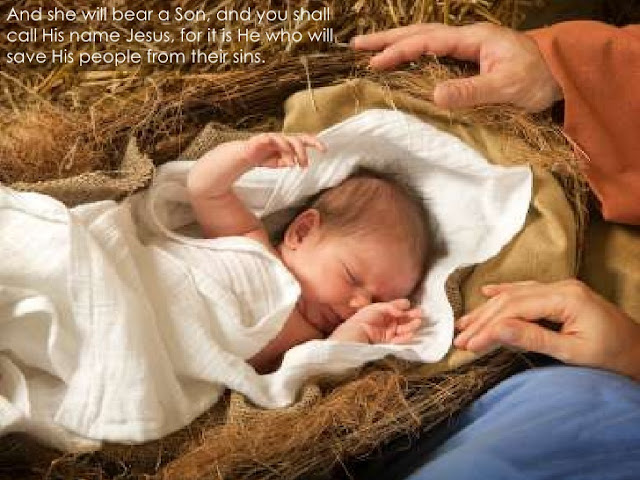
Significance of the Swaddling Cloths

I just realized it's been more than a month since I wrote a blog post. In addition to doctors' visits, preparations for Christmas, and several snowstorms, I've been working hard on my new writing project--a book which I'm titling Following in Footsteps of Faith. It is a sequel to Frontiers of Faith,  the story of my grandparents, Charles & Florence Personeus, pioneer missionaries to Alaska, 1917-1982. The new book tells the faith-building true stories of my adventures in following in their footsteps even from early childhood.

Courtesy Google.com
Before I continue work on my new book, I want to pause and wish you all a blessed Christmas and  God's best in the New Year.

From the first Christmas I can remember until now, my family has always read the Christmas story from Matthew and Luke on Christmas Eve. We've sung the carols and reenacted the precious story every year in church. This year, however, I gained insight into the wondrous story that I had never known previously: the significance of the swaddling cloths to the shepherds.

Bethlehem, meaning "House of Bread," is only 5 miles from Jerusalem. King David watched his father's sheep on the hillsides around Bethlehem, the town designated in Micah 5:1 as the birthplace of the coming Messiah, who would be called "The Bread of Life."

Mary and Joseph lived in Nazareth, near the Sea of Galilee, about 80 miles north of Bethlehem. We all know the Bible story of the taxation census ordered by Caesar Augustus that required all men to return to their hometowns to register. Joseph, as well as Mary, were both of the lineage of King David. In spite of Mary's advanced pregnancy, she accompanied Joseph on the journey. As they arrived in Bethlehem, she went into labor.

Bethlehem at that time was overwhelmed with travelers who had come to register. Frantically, Joseph searched for a room. All he could find was a shepherd's cave. At least it was clean and provided shelter. Mary gave birth and wrapped the Babe in swaddling cloths and laid Him in a manger, a feeding trough for animals. This fact is mentioned three times within 20 verses in Luke 2, calling attention to its importance.

Out on the hillside, shepherds were watching their sheep that night. Suddenly, the angel of the Lord appeared to them and announced the birth of "Christ the Lord," saying,

Courtesy Pinterest.com
And this will be the sign to you: you will find the Babe wrapped in 
swaddling cloth, lying in a manger.
  
The message was punctuated by the singing of a radiant angelic choir:

Glory to God in the highest,
And on earth peace, goodwill toward men!

Now, these were not ordinary shepherds. The shepherds of Bethlehem were "Levitical Shepherds," chosen and trained to take care of the sheep that were to be used as sacrificial lambs in the Temple in nearby Jerusalem.

The Law of Moses required that the sacrificial lambs be "spotless and without blemish." To assure that, special treatment was required. When an ewe was ready to give birth, she was taken to a special birthplace, a cave designated for the birth of the sacrificial lambs. The newborn lamb was carefully wrapped in swaddling cloths, bandage-like strips of cloth to protect it from blemish, and laid in the manger there.

When the shepherds heard the angel's news, they knew immediately where they could go to see the Baby--to their cave where the sacrificial lambs were born.

As soon as the angels went back into heaven, the shepherds hurried to see the newborn Babe, the One of whom John the Baptist later called "The Lamb of God who takes away the sin of the world!" (John 1:29).

Today, amid all the tinsel, lights, sounds, and gifts, let's not forget "the Reason for the Season"!

The Sacrificial Lamb is now our Shepherd.

He is Emanuel, God with us!

He is the the Lamb without spot or blemish--the One who was in all points tempted as we are yet without sin,  the One who can sympathize with our weaknesses and give us help in our time of need. Praise His wonderful Name!

Consider giving a book for Christmas. See http://annaleeconti.com/books.html


Thursday, November 14, 2019

Beauty for Ashes


On that clear Sunday morning of May 18, 1980, my mother walked the two blocks from their house to the church they pastored in Kittitas, Washington. When she stepped out the door, she noticed a small cloud on the southwest horizon. By the time she arrived at the church, billows of dark ash clouds boiled overhead, blocking out the sun, turning the day to night in just a few minutes.

That was the day Mt. St. Helens, a volcano in the Cascade Mountains of Washington, blew its top. The eruption was witnessed by vulcanologist David Johnston, who was camped on a ridge 6 miles from the volcano, and Keith and Dorothy Stoffel, who were making an aerial survey of the volcano that morning. Miraculously, they lived to tell their stories.

At 8:32 a.m., a local magnitude 5.1 earthquake set off a landslide on the lip of the crater. Within seconds, the whole north face of the mountain began to move and collapsed, releasing super-heated gases and trapped magma in a massive cloud. Hot gases and rock debris were blown out of the mountain face at nearly supersonic speeds, wiping out everything within 8 miles almost instantly.

The shock wave rolled over the forest for another 19 miles, leveling century-old trees, leaving all the trunks neatly aligned to the north. Beyond this downed-tree zone, the forest remained standing but was seared lifeless. The area devastated by the direct force covered nearly 230 square miles.

Shortly after the lateral blast, a second vertical explosion occurred at the summit of the volcano, sending a mushroom cloud of ash and hot gases more than 12 miles into the atmosphere.

During the next 9 hours, about 540 million tons of ash from Mt. St. Helens fell like rain over an area of more than 22,000 square miles. The total volume of the ash before its compaction by rainfall was about 0.3 cubic mile, equivalent to an area the size of a football field piled about 150 miles high with fluffy ash. My sister lived in Yakima, about 85 miles northeast of the volcano. She measured 7 inches of ash on her porch. In the next valley north, ash accumulated to 4 inches on my parents' porch--like snow, but it didn't melt. When I visited my family 2 months later, it was just blowing around in the wind and making everything gritty, even my teeth!

Heat from the initial eruption melted and eroded the glacial ice and snow around the remaining part of the mountain. The water mixed with dirt and debris to create mud flows, which reached speeds of 90 mph and demolished everything in their path.

The 1980 Mt. St. Helens eruption was the most destructive in U.S. history. Fifty-seven people died, and thousands of animals were killed, according to the U. S. Geologic Survey. More than 200 homes were destroyed, and more than 185 miles of roads and 15 miles of railways were damaged. 

Ash clogged sewage systems, damaged cars and buildings, and temporarily shut down air traffic over the Northwest. The International Trade Commission estimated damages to timber, civil works, fisheries, and agriculture to be $1.1 billion. Hot ash caused forest fires, and snow melt from the top of the mountain caused floods. Volcanic ash spread across the Northwest. More than 900,000 tons of ash were cleaned up from areas around Washington.

Mt. St. Helens ash
Today, scientists keep a close watch on Mount St. Helens and other volcanoes in the Pacific Northwest. The volcano's location on the Cascadian Subduction Zone means another eruption is inevitable.

Yet, out of the ashes and destruction has come beauty. The ash has made the farmlands of Washington even more fertile. 

While Mt. St. Helens lost over 1,300 feet in height (previously, the mountain was 9,677 feet; it is now 8,365 feet) and scenic Spirit Lake was severely impacted, over time, the landscape is recovering. Different but still beautiful, it still attracts tourists.


Helenite also comes in shades of blue and red.
Unexpected and even more surprising, while cleaning up after the eruption, it was accidentally discovered that, when heated, the elements in the volcanic rock and ashes would fuse to form a rich, green gem similar to an emerald. The process was later perfected in strict lab conditions to create the magnificent deep green Helenite gemstone. Called Helenite or Mt. St. Helens Emerald, it has earned the title "America's Emerald." With its sparkle, color, and cut, it delivers the beauty of precious emeralds without the big price tag.


Isn't that just like our God? In Isaiah 61:3, He promised to comfort all who mourn:

To give them beauty for ashes, 
the oil of joy for mourning, 
the garment of praise for the spirit of heaviness; 
that they may be called trees of righteousness, 
the planting of the Lord, 
that He may be glorified.

As I look back over my life, I remember times when I felt my life was in ashes. But God has made something beautiful out of the devastation. Can you think of a time when God turned your ashes into something beautiful?


Note: I'm still struggling to get my blood pressure down to normal. Still getting many tests and trying new meds. Significant deterioration in my cervical and lumbar spine has been discovered, and physical therapy is recommended. That will be time consuming. I will still make my new book a priority. I'm making good progress. And I will try to write a blog post from time to time. Thank you for your continued prayers.